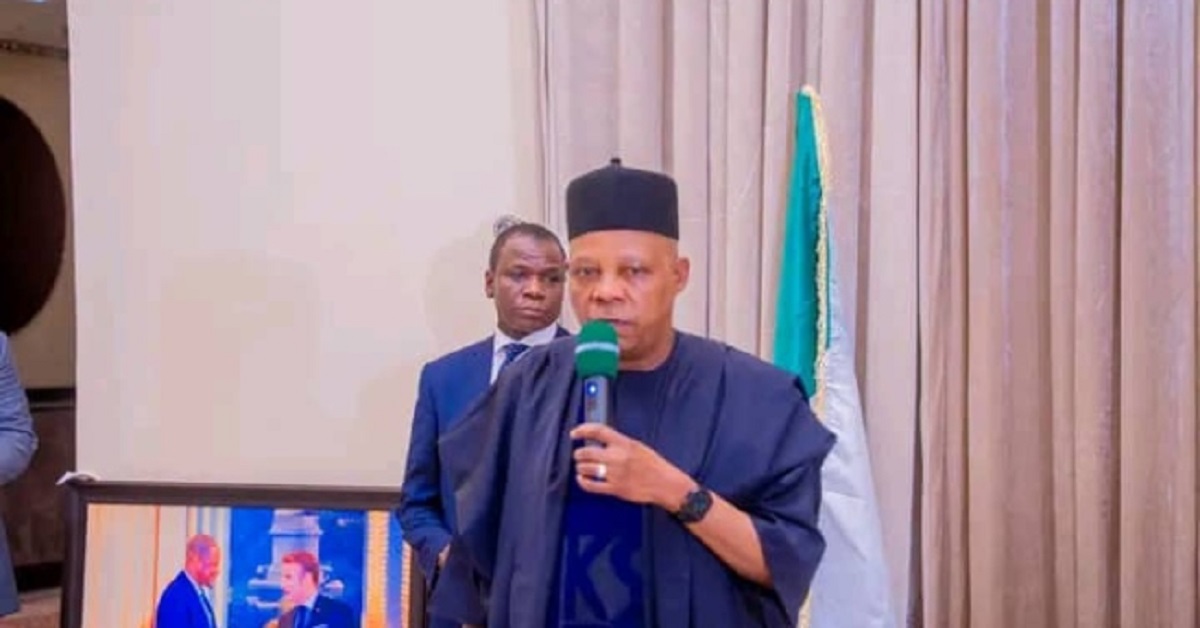
Vice President Kashim Shettima has said that Africa’s future economic success depends on its ability to integrate the informal sector into the formal intra-African trade framework.
Shettima stated this on Monday, while declaring open the 4th African Union Micro, Small and Medium Enterprises (MSMEs) Forum in Abuja.
While he said the framework will be achieved particularly through the African Continental Free Trade Area (AfCFTA), he warned that if Africa failed to harness the potential in the informal sector for small businesses to grow, the continent would “keep going round the same cycle of despair.”
A statement later published on his official X handle, noted that the promise of a better future for Africa does not depend on the skyscrapers being constructed in capitals of nations or the transactions in stock exchanges, but lies in the reality that the “potential of the informal sector, which accounts for nearly 90 percent” of the continent’s workforce, must be harnessed.
He demanded the integration of the informal economy into formal intra-African trade, noting that this was why small businesses have remained at the heart of policy formulation in Nigeria.
“There can be no African prosperity without a strong MSME ecosystem. This forum is a continental call to action. We owe it to ourselves, to our children, and to generations unborn, to integrate our informal economy into the framework of formal intra-African trade.
“I am confident that through our collaborative efforts, this forum will mark a turning point.
“We hope to see our shared aspirations translated into concrete actions that empower our MSMEs and propel Africa towards a brighter, more sustainable future,” the Vice President told delegates and other participants at the forum.
Shettima underscored the crucial role MSMEs play in the development and growth of Africa, observing that beyond employing millions of Africans, “they are engines of inclusive growth and effective tools for poverty alleviation.
“In Nigeria alone, MSMEs contribute a staggering 48 per cent to our national GDP and employ over 84 per cent of our workforce. They are a mirror to our future, and they explain why we are deepening our investments to expand the capacity of this sector.”
Beyond building local infrastructure for entrepreneurial expansion, the Vice President implored African countries to entrench cross-border cooperation since their destinies are bound together as a continent.
He identified some of the obstacles confronting MSMEs in Africa to include limited access to affordable finance, describing this particular challenge as a recurring nightmare, just as he noted that with the African Continental Free Trade Area (AfCFTA), there is still hope.
Shettima said, “It costs our continent not just money—it costs us momentum. But we must find hope in the promise of the African Continental Free Trade Area (AfCFTA).
This is why I am particularly excited about the theme of this forum—’Building Resilient MSMEs through Digital Innovation, Market Access & Affordable Financing for Africa.’ The timing is perfect. The vision is clear.”
Shettima acknowledged what he termed a remarkable surge in digital adoption across Africa, saying technology was achieving what politics had to actualised over the years.
He noted, however, that for the momentum to be sustained, policymakers must live up to their duties by “investing in robust digital infrastructure, bridging the digital literacy gap, and establishing regulatory frameworks that do not stifle innovation.”
Regretting the continued dependence of MSMEs on traditional financial institutions, the vice president, however, expressed hope that change was unfolding, with fintech firms across Africa now using alternative data to assess creditworthiness and extend microloans to the previously excluded.